Mobile Security 2026: Hardware Protection Essentials for Your Devices
Mobile Security in 2026: 3 Essential Hardware-Based Protections for Your Device
The landscape of mobile security is in a constant state of flux, evolving at an unprecedented pace. As we stride towards 2026, the sophistication of cyber threats continues to escalate, making software-based defenses alone increasingly insufficient. The battle for digital safety is shifting, and the front lines are now firmly embedded within the physical architecture of our devices. This is where mobile hardware security emerges not just as an advantage, but as an absolute necessity. Protecting our personal and professional lives, which are increasingly intertwined with our smartphones and tablets, demands a deeper, more resilient layer of defense. This comprehensive guide will explore the three essential hardware-based protections that will define the robustness of your mobile device’s security in the coming years.
In an era where every tap, swipe, and transaction carries potential risks, understanding the bedrock of your device’s security is paramount. We’re moving beyond simple passwords and basic encryption. The future of mobile security hinges on impenetrable hardware-level safeguards designed to resist even the most advanced attacks. These aren’t just theoretical concepts; they are already being integrated into the latest mobile processors and components, working silently but powerfully to keep your data safe. From securing biometric data to protecting cryptographic keys, hardware-based solutions offer a fortress-like defense against malicious actors.
The ubiquity of mobile devices means that they are prime targets for cyber criminals. Whether it’s phishing attempts, malware, or sophisticated zero-day exploits, the avenues for attack are numerous. Without robust mobile hardware security, the integrity of our digital identities, financial information, and sensitive communications remains perpetually vulnerable. This article will delve into the intricacies of Trusted Execution Environments (TEEs), the ironclad security offered by Secure Enclaves, and the evolving power of advanced biometric authentication, explaining why these three pillars are indispensable for any mobile device user in 2026.
The Foundation: Understanding Hardware-Based Security
Before we dive into the specific technologies, it’s crucial to grasp what distinguishes hardware-based security from its software counterpart. Software security, while vital, operates within the parameters of an operating system and can be vulnerable to exploits that compromise the OS itself. Hardware security, on the other hand, builds protection directly into the physical components of the device. This creates a fundamentally more secure environment, isolated from the main operating system and applications, making it significantly harder for attackers to bypass.
Think of it this way: software security is like a sturdy lock on a door, but if the door frame itself is weak, a determined intruder might still get in. Hardware security, however, reinforces the entire door frame, making the entire structure far more resilient. This foundational strength is what makes mobile hardware security so critical for the challenges of 2026. It establishes a root of trust that software can then build upon, ensuring that even if parts of the operating system are compromised, critical functions and data remain protected.
The benefits of hardware-based security extend beyond mere resilience. It offers enhanced performance for cryptographic operations, better protection against physical tampering, and a more reliable basis for secure boot processes. By embedding security at the lowest levels of the device’s architecture, manufacturers can create a trusted environment that is resistant to a wide array of attacks, from sophisticated malware to supply chain compromises. This approach is not just about patching vulnerabilities but about preventing them at their core, establishing a proactive defense rather than a reactive one.
Moreover, hardware-based security often involves dedicated processors or isolated areas within the main processor, specifically designed to handle sensitive operations. These specialized units are engineered with security as their primary function, incorporating features like anti-tampering mechanisms and secure memory access. This dedicated approach ensures that critical security processes are not competing for resources or exposed to the same vulnerabilities as general-purpose computing tasks. In essence, it’s a security guard permanently stationed at the most vital entry points of your mobile device.
The rise of advanced persistent threats (APTs) and state-sponsored cyber-attacks further underscores the importance of this shift. These adversaries often possess the resources and expertise to penetrate even well-defended software systems. Against such formidable threats, only the inherent robustness of hardware-based protections can provide a truly formidable defense. As our mobile devices become central to every aspect of our lives – from banking and healthcare to communication and entertainment – the demand for this unparalleled level of security will only intensify. Understanding these foundational principles is the first step in appreciating why the following three technologies are indispensable for mobile hardware security in 2026.
1. Trusted Execution Environments (TEEs): The Secure Sandbox
One of the most significant advancements in mobile hardware security is the Trusted Execution Environment (TEE). A TEE is a secure area within a main processor that guarantees code and data loaded inside it are protected with respect to confidentiality and integrity. It runs in parallel with the main operating system (OS) but is isolated from it, creating a ‘secure world’ where sensitive operations can be performed without interference from the ‘normal world’ where the main OS and applications reside.
Imagine your smartphone’s processor as a large building. The main operating system and all your apps are running in the general-purpose offices and common areas. A TEE is like a highly fortified, soundproof vault within that same building, with its own independent security systems and access controls. Any sensitive operation—like processing biometric data for authentication, handling digital rights management (DRM) content, or securing payment transactions—is routed through this vault. Even if the main OS is compromised by malware, the TEE remains secure, protecting the critical data and processes within.
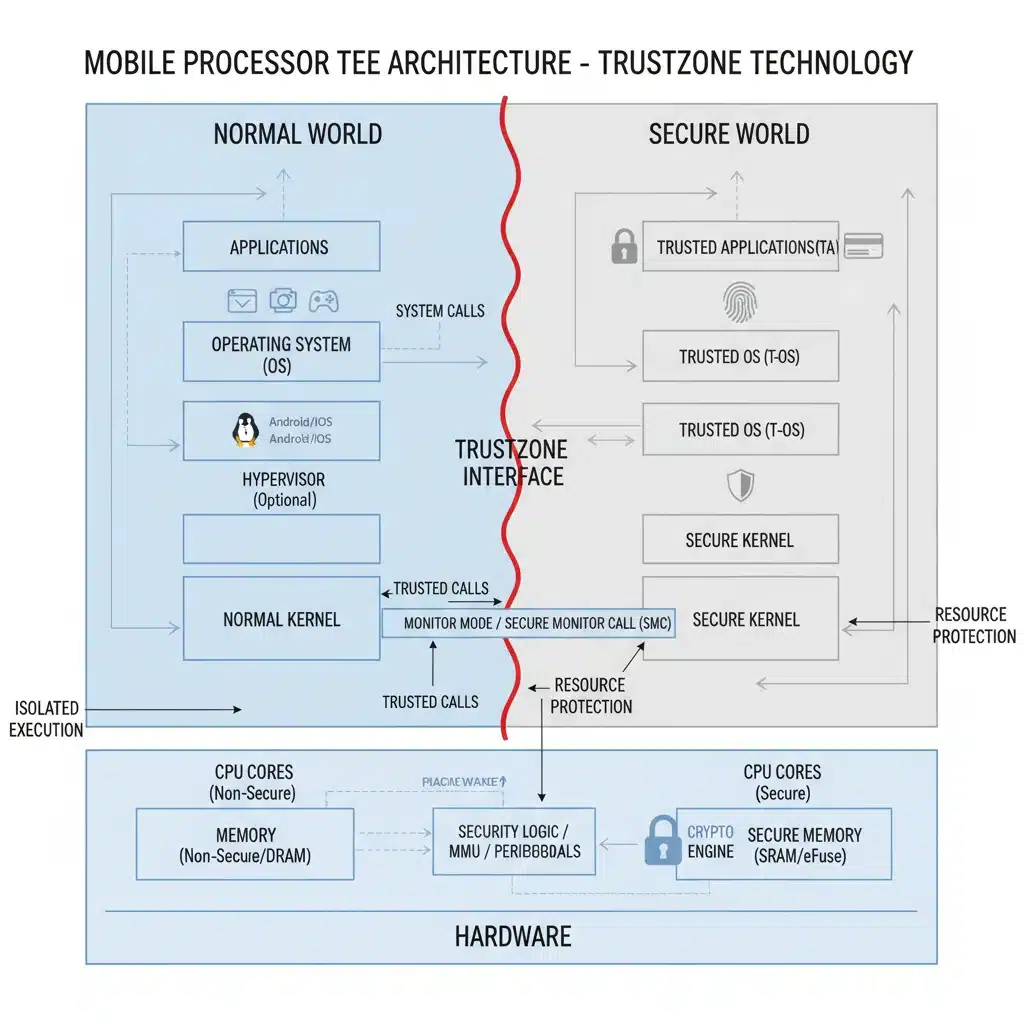
Leading mobile processors, such as those from Qualcomm (with its Secure Processing Unit) and ARM (with its TrustZone technology), have integrated TEEs as a core component. TrustZone, for instance, partitions the hardware and software resources of the device into two distinct states: the secure world and the normal world. The secure world has access to all the device’s resources, while the normal world has limited access and must request services from the secure world for sensitive operations. This architectural separation is fundamental to the strength of TEEs.
The applications for TEEs are vast and growing. For instance, when you use fingerprint or facial recognition to unlock your phone or authorize a payment, the raw biometric data is processed and matched within the TEE. This means your unique biometric template never leaves the secure environment, even if your phone is infected with a sophisticated virus. Similarly, digital keys used for encrypting and decrypting data can be stored and utilized exclusively within the TEE, making them incredibly difficult for attackers to extract.
Furthermore, TEEs play a crucial role in secure boot processes. Before the main operating system even loads, the TEE can verify the integrity of the bootloader and the OS kernel, ensuring that no malicious code has been injected at an early stage. This ‘chain of trust’ starting from the hardware root of trust within the TEE helps guarantee that the device boots into a known, secure state. Without a TEE, an attacker could potentially inject malware into the boot process, gaining control before any software-based security measures have a chance to activate.
The evolution of TEEs will likely see them becoming even more compartmentalized and specialized, with multiple secure environments coexisting for different sensitive tasks. This modular approach will further enhance mobile hardware security, allowing for fine-grained control over which processes have access to which sensitive resources. For consumers, this means greater peace of mind, knowing that the most critical aspects of their digital lives are shielded by an impenetrable hardware-level defense, making TEEs an indispensable component of mobile security in 2026.
2. Secure Enclaves: Isolated Cryptographic Processing
While often used interchangeably with TEEs, a Secure Enclave typically refers to a more specialized, even more isolated, and often smaller hardware component or a dedicated part of a TEE, specifically designed for highly sensitive cryptographic operations and data storage. Apple’s Secure Enclave Processor (SEP) is perhaps the most well-known example, setting a high bar for mobile hardware security.
The Secure Enclave operates as a co-processor alongside the main application processor, but with its own secure boot, dedicated memory, and cryptographic engine. It’s purpose-built to handle tasks such as storing cryptographic keys, processing biometric data (like fingerprints and facial scans), and facilitating secure transactions without ever exposing this sensitive information to the main operating system or any applications. The key distinction lies in its extreme isolation and narrow focus on critical security functions.
Consider the Secure Enclave as an ultra-secure safe deposit box within the already fortified vault of a TEE. It’s where the most valuable digital assets – your unique biometric templates, device-specific cryptographic keys, and other secrets – are kept. The main processor can request the Secure Enclave to perform operations using these secrets (e.g., ‘authenticate this user’ or ‘decrypt this data’), but it never actually sees the secrets themselves. This design principle, known as ‘data segregation,’ is fundamental to its strength.
For example, when you use Face ID or Touch ID on an iPhone, your facial scan or fingerprint is captured by the sensors. This raw data is then securely transmitted directly to the Secure Enclave. The Secure Enclave processes this data, creates a mathematical representation (a template), and compares it to the stored template. Only a ‘yes’ or ‘no’ authentication result is sent back to the main processor. At no point does the main processor or any application ever have access to your actual biometric data or the template stored within the Secure Enclave. This level of isolation makes it exceedingly difficult for even sophisticated attackers to compromise your biometric identity.
Beyond biometrics, Secure Enclaves are crucial for protecting cryptographic keys. These keys are the backbone of encryption, used to secure everything from your communications to your stored files. If an attacker gains access to these keys, all your encrypted data becomes vulnerable. By storing and using these keys exclusively within the Secure Enclave, devices can perform encryption and decryption operations with the assurance that the keys themselves are never exposed to potentially compromised software environments. This is a cornerstone of robust mobile hardware security.
The future of Secure Enclaves will likely involve even more sophisticated anti-tampering measures, making it virtually impossible for physical attacks to extract data. This could include advanced sensors that detect voltage fluctuations, temperature changes, or even attempts to physically probe the chip. As mobile devices become integrated into critical infrastructure and sensitive financial systems, the role of these isolated, cryptographic processing units will only grow, solidifying their position as an essential hardware-based protection for 2026 and beyond.
3. Advanced Biometric Authentication: Beyond the Fingerprint
Biometric authentication has moved far beyond simple fingerprint scanners. In 2026, advanced biometric systems, leveraging sophisticated hardware, will provide a seamless yet incredibly secure method of verifying user identity. These systems rely on unique biological characteristics to grant access, and their security is intrinsically linked to the hardware protections discussed above.
While fingerprint scanning remains prevalent, technologies like advanced facial recognition (e.g., Apple’s Face ID), iris scanning, and even behavioral biometrics are becoming increasingly sophisticated. What makes these ‘advanced’ is not just the sensor technology itself, but how the data is captured, processed, and stored within the device’s secure hardware components like TEEs and Secure Enclaves.
Consider advanced facial recognition. Unlike older, 2D facial recognition that could be fooled by a photograph, modern systems use hardware like infrared cameras and dot projectors to create a detailed 3D map of a user’s face. This 3D data is then securely transmitted to and processed within a Secure Enclave. The Enclave creates a mathematical representation of this 3D map and compares it to the stored template. Because the system is analyzing depth and intricate facial features, it’s virtually impossible to trick with a flat image or even a sophisticated mask, providing a high level of mobile hardware security.
Iris scanning is another powerful biometric method. The iris, the colored part of the eye, has a unique and highly complex pattern that is incredibly stable throughout a person’s life. Dedicated hardware sensors can capture this intricate pattern, and similar to facial recognition, the processing and comparison occur within a secure hardware environment. The sheer uniqueness and complexity of the iris pattern make it an exceptionally secure form of authentication, far more reliable than a simple password.
The integration of these biometric technologies with TEEs and Secure Enclaves is what elevates them from convenient access methods to robust security features. Without the underlying hardware protection, even the most advanced biometric sensor could be vulnerable to software exploits that intercept or mimic the biometric data. The hardware ensures that the biometric templates are never exposed, and the authentication process is performed in an isolated, trusted environment.

Furthermore, we are seeing the rise of multi-modal biometrics, where devices combine several biometric inputs for even greater security. This could involve combining facial recognition with voice recognition, or fingerprint with behavioral patterns (how you type, swipe, or hold your device). The hardware infrastructure is designed to handle this increased complexity, processing multiple data streams simultaneously within the secure environment to build an even more robust profile of the legitimate user.
Looking ahead to 2026, we can expect further advancements in continuous authentication using biometrics. Instead of authenticating once to unlock the device, future systems might continuously verify identity based on subtle physiological or behavioral cues, all processed securely by hardware. This could involve gait analysis, heart rate monitoring, or even brainwave patterns, moving towards a future where your device is always aware of your legitimate presence, providing unparalleled mobile hardware security without intrusive constant prompts.
The Interplay of These Protections
It’s important to understand that these three hardware-based protections—TEEs, Secure Enclaves, and Advanced Biometric Authentication—do not operate in isolation. Instead, they form an interdependent ecosystem that collectively enhances the overall mobile hardware security posture of a device. The strength of one often relies on the integrity and functionality of the others.
For instance, advanced biometric authentication systems are only as secure as the environment in which their data is processed and stored. This is precisely where TEEs and Secure Enclaves come into play. The raw biometric data captured by the sensors is routed directly to these secure hardware components, where it is processed, compared to stored templates, and authenticated. The critical biometric templates themselves are stored within the Secure Enclave, shielded from the main operating system and any potential software vulnerabilities. Without the secure processing and storage offered by TEEs and Secure Enclaves, even the most sophisticated biometric sensor could be bypassed or compromised.
Similarly, cryptographic keys, which are fundamental to securing all data on a mobile device, find their ultimate protection within the Secure Enclave. These keys are generated, stored, and utilized exclusively within this isolated hardware environment. When an application needs to encrypt or decrypt data, it requests the Secure Enclave to perform the operation using the protected keys. The keys themselves never leave the enclave, ensuring that even if the operating system is heavily compromised, the fundamental encryption capabilities of the device remain intact. This layered defense is a hallmark of robust mobile hardware security.
The Trusted Execution Environment (TEE) acts as a broader secure sandbox, hosting not only components that interact with the Secure Enclave but also other critical security services. These might include secure boot verification, digital rights management (DRM) protection for copyrighted content, and secure payment processing modules. The TEE ensures that these sensitive operations are performed in an environment isolated from the main OS, providing an additional layer of defense that complements the ultra-secure functions of the Secure Enclave.
This synergistic relationship creates a formidable defense against a wide array of cyber threats. An attacker would not only need to bypass the software-level security but then also penetrate multiple layers of hardware-level isolation, each designed with specific anti-tampering and security features. This multi-layered approach significantly raises the bar for cybercriminals, making successful attacks against well-protected mobile devices incredibly difficult and costly. As we approach 2026, the seamless integration and continuous enhancement of these hardware protections will be paramount for maintaining the integrity and trustworthiness of our mobile digital lives.
The Future Landscape of Mobile Hardware Security (2026 and Beyond)
Looking beyond 2026, the evolution of mobile hardware security will continue to accelerate. We can anticipate several key trends and innovations that will further solidify the defenses of our mobile devices.
One significant area of development will be in post-quantum cryptography. As quantum computing advances, current encryption standards could become vulnerable. Hardware manufacturers are already researching and integrating quantum-resistant cryptographic algorithms into TEEs and Secure Enclaves. This proactive approach ensures that even with the advent of powerful quantum computers, the foundational security of our mobile devices remains uncompromised, protecting long-term data confidentiality.
Another emerging trend is the deeper integration of AI and machine learning (ML) directly into hardware security modules. AI can be used for anomaly detection within the secure environment, identifying unusual access patterns or behaviors that might indicate a sophisticated attack. For example, an AI engine within the TEE could monitor the integrity of critical security processes and flag any deviations in real-time, providing an immediate response to potential threats before they can fully materialize. This intelligent, adaptive security will be a game-changer for mobile hardware security.
Furthermore, the concept of ‘zero-trust’ architectures will become more prevalent at the hardware level. This means that every component, every process, and every data access request, even within the secure hardware, will be continuously verified before being granted access. This granular control and constant verification will minimize the attack surface and prevent unauthorized actions from spreading laterally within the secure environment.
Physical security enhancements will also continue to evolve. Beyond current anti-tampering measures, future mobile devices might incorporate self-healing hardware that can detect and mitigate physical intrusions, or even render sensitive data irrecoverable if tampering is detected. This level of physical resilience will make it even harder for sophisticated attackers to extract information directly from the chip.
Finally, the growing trend of decentralized identity and verifiable credentials will lean heavily on hardware-based security. Secure Enclaves and TEEs will be crucial for storing and managing digital identities, ensuring that users have complete control over their personal data and can share verifiable claims securely, without relying on centralized authorities. This shift empowers users and reduces the risk of large-scale data breaches.
In essence, the future of mobile hardware security in 2026 and beyond is one of continuous innovation, driven by the need to stay ahead of ever-evolving threats. By embracing these advanced hardware-based protections, mobile devices will not only remain powerful tools but also trusted guardians of our digital lives.
Conclusion: Fortifying Your Mobile Future with Hardware Security
As we navigate the increasingly complex digital landscape, the importance of robust mobile hardware security cannot be overstated. The year 2026 will undoubtedly bring new challenges and sophisticated cyber threats, but with the foundational protections offered by Trusted Execution Environments (TEEs), Secure Enclaves, and advanced biometric authentication, our mobile devices are set to become more resilient than ever before.
These three essential hardware-based protections work in concert to create a multi-layered defense that is fundamentally more secure than software-only solutions. They establish a root of trust, isolate sensitive operations, protect cryptographic keys, and secure our most personal data—our biometrics—from malicious actors. By embedding security at the deepest levels of the device’s architecture, manufacturers are providing users with an unparalleled level of peace of mind.
For consumers and enterprises alike, understanding and prioritizing devices equipped with these advanced mobile hardware security features will be crucial. When choosing a new smartphone or tablet, delving into its security specifications, particularly regarding its hardware-based protections, will be as important as evaluating its camera or processing power. A device with strong hardware security is not just a technological marvel; it’s a personal data fortress.
The ongoing evolution of these technologies, including the integration of post-quantum cryptography, AI-driven anomaly detection, and zero-trust principles at the hardware level, promises an even more secure future. As our lives become inextricably linked to our mobile devices, the commitment to enhancing mobile hardware security will be the cornerstone of our digital safety and privacy. Embrace these advancements, and fortify your mobile future against the threats of tomorrow.