On-Device Machine Learning: Boosting Smartphone Privacy in 2026

The Rise of On-Device Machine Learning: 3 Critical Privacy Benefits for US Smartphone Users in 2026
In an increasingly digital world, the sanctity of our personal data has become a paramount concern. Every tap, swipe, and voice command on our smartphones generates a wealth of information, much of which is often sent to distant cloud servers for processing. However, a significant technological shift is underway that promises to redefine how our data is handled: the widespread adoption of on-device machine learning. By 2026, this innovative approach is set to deliver three critical privacy benefits to US smartphone users, fundamentally altering our relationship with technology and safeguarding our digital lives. This article delves deep into these transformative advantages, exploring how on-device machine learning is not just a technical upgrade but a foundational change for digital privacy.
Understanding On-Device Machine Learning
Before we explore the benefits, let’s clarify what on-device machine learning entails. Traditionally, when you interact with an application that uses artificial intelligence (AI) – such as a voice assistant, a photo recognition tool, or a predictive text engine – your data is often transmitted to a remote server. There, powerful cloud-based algorithms process the information, and the results are sent back to your device. This cloud-centric model has been the backbone of many AI services, offering immense computational power that individual devices couldn’t match.
However, this convenience comes with inherent privacy risks. Sending data to the cloud means it traverses networks, rests on third-party servers, and is subject to various data retention policies and potential vulnerabilities. Each step in this journey presents an opportunity for data breaches, unauthorized access, or misuse. This is where on-device machine learning steps in as a game-changer.
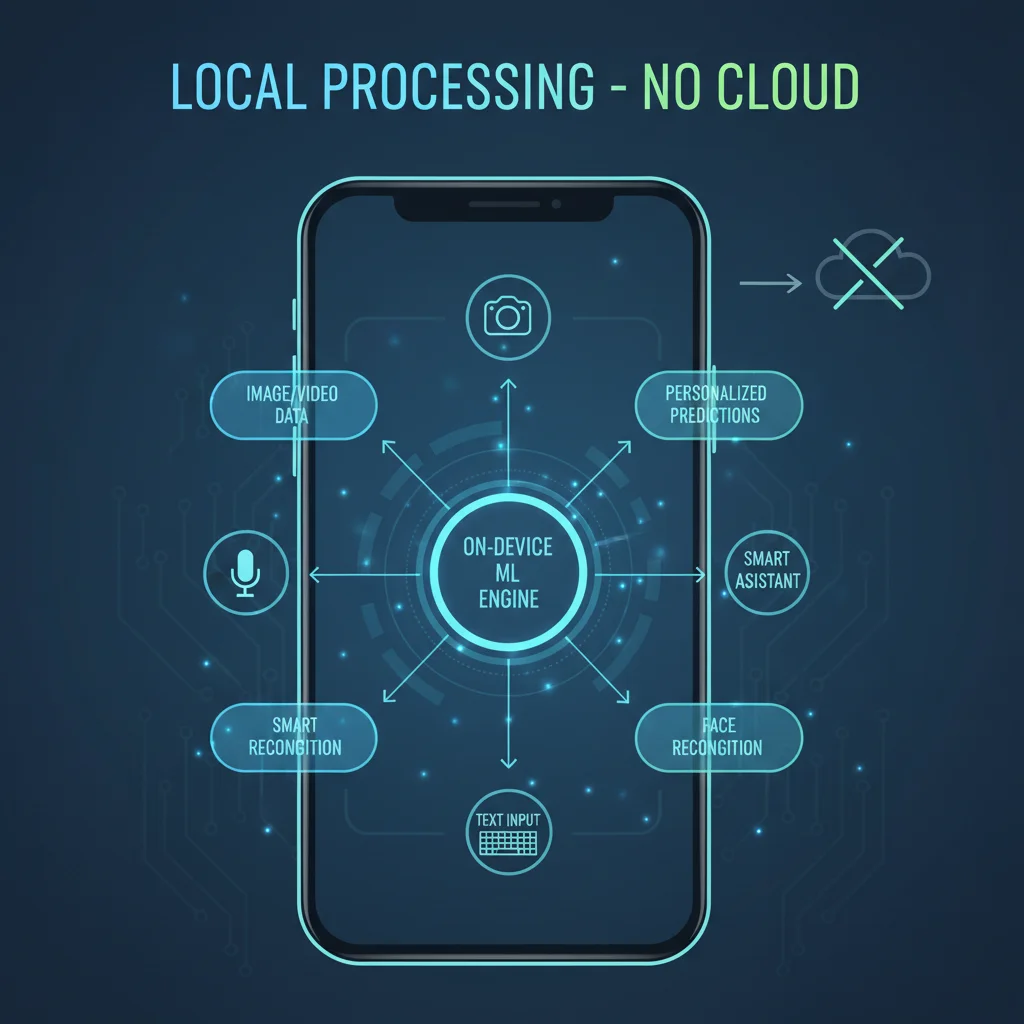
On-device machine learning, as the name suggests, involves running AI algorithms directly on your smartphone. Instead of sending raw data to the cloud, the machine learning models themselves are downloaded to the device. Your data then stays local, processed by the phone’s dedicated AI chips (Neural Processing Units or NPUs) or optimized software. This architectural shift means that sensitive personal information – from your voice recordings to your photo library and typing patterns – never leaves your device for AI processing. The implications for privacy are profound, and by 2026, this technology is expected to be a standard feature across most new smartphones in the US, providing a robust layer of protection that was previously unattainable.
Benefit 1: Enhanced Data Security and Reduced Exposure
The most immediate and impactful benefit of on-device machine learning is the significant enhancement of data security and a drastic reduction in data exposure. When your personal data remains on your device, it is inherently more secure. This eliminates several common vectors for data breaches and unauthorized access that plague cloud-based systems.
Minimizing Cloud Transmission Risks
Every time your data travels across the internet to a cloud server, it faces a multitude of risks. It can be intercepted during transmission, stored insecurely on the server, or accessed by malicious actors who breach the cloud provider’s infrastructure. With on-device machine learning, this entire process is circumvented. Your voice commands for a virtual assistant, for example, are processed locally, and only the *result* of the command (e.g., “play this song”) might be sent to a music streaming service, not the raw audio of your voice. This significantly shrinks the attack surface for cybercriminals.
Protection Against Server-Side Breaches
High-profile data breaches at major companies are a recurring nightmare for consumers. These incidents often expose millions of user records, leading to identity theft, financial fraud, and a profound loss of trust. Many of these breaches occur when attackers compromise central cloud servers. By keeping sensitive data on the device, on-device machine learning effectively insulates users from these large-scale server-side vulnerabilities. Even if a cloud service associated with your app is compromised, the personal data processed locally by your phone’s AI remains untouched and secure.
Reduced Third-Party Access and Data Monetization
A persistent concern for smartphone users is the extent to which their data is accessed, analyzed, and potentially monetized by third-party companies. While regulations like GDPR and CCPA aim to curb this, the underlying architecture of cloud-based AI often necessitates data sharing. On-device machine learning fundamentally changes this dynamic. Since the data never leaves your device, the opportunities for third parties to collect, aggregate, and sell your personal information are drastically reduced. This empowers users with greater control over their digital footprint and enhances their privacy by design, making it much harder for companies to profit from your personal data without explicit, granular consent.
Consider the example of a health monitoring app. If it uses cloud-based AI, your biometric data, activity levels, and sleep patterns might be sent to external servers for analysis. With on-device machine learning, the AI model processes this sensitive health data directly on your phone, providing insights and recommendations without ever transmitting your raw, identifiable information off the device. This level of data sovereignty is a huge leap forward for privacy-conscious users.
Benefit 2: Enhanced Personalization Without Compromising Privacy
One of the paradoxes of modern technology has been the trade-off between personalization and privacy. To get highly tailored experiences, users often had to surrender vast amounts of personal data to cloud services. On-device machine learning shatters this paradigm, enabling deeply personalized experiences while keeping your sensitive information private.
Truly Personalized User Experiences
Imagine a smartphone that truly understands your habits, preferences, and context without ever sending your private data to a corporate server. On-device machine learning makes this a reality. Your device can learn your speaking patterns to improve voice recognition, understand your typing style for more accurate predictive text, and analyze your app usage to optimize battery life and performance – all without a single byte of personal data leaving your phone. This leads to an incredibly responsive and intuitive user experience that adapts uniquely to you, rather than conforming to generalized cloud-based models.
Contextual Awareness and Predictive Capabilities
Smartphones equipped with on-device machine learning can develop a sophisticated understanding of your daily routines and immediate context. For instance, your phone could proactively suggest relevant apps or information based on your location and time of day, knowing your commute patterns or workout schedule. It could learn your preferred music for different activities or automatically adjust settings (like screen brightness or notification volume) based on your environment. Since this learning happens directly on the device, the rich data used for these predictions – your location history, sensor data, app usage – remains private and under your control. This allows for a level of predictive assistance that feels truly intelligent and helpful, without the lurking fear of constant surveillance.
Improved Accessibility and Adaptive Features
For users with accessibility needs, on-device machine learning offers transformative potential. Features like real-time captioning for videos, enhanced speech-to-text accuracy for diverse accents, or personalized haptic feedback can all be powered by local AI models. These features can adapt and improve over time based on individual user input, providing a more inclusive and effective experience. Crucially, the sensitive personal data (such as voice samples for transcription or unique interaction patterns) required for these adaptations never leaves the device, ensuring that accessibility enhancements do not come at the cost of privacy.
The ability of on-device machine learning to offer hyper-personalization while maintaining strict data privacy is a monumental leap. It demonstrates that users don’t have to choose between a tailored experience and data security; they can have both. By 2026, this balance will be a key differentiator for smartphone manufacturers and a major win for consumers.
Benefit 3: Reduced Dependency on Cloud Infrastructure and Improved Performance
Beyond security and personalization, on-device machine learning brings a host of operational advantages that indirectly bolster privacy, primarily by reducing reliance on external cloud infrastructure and enhancing device performance. This benefit is often overlooked but plays a crucial role in creating a more private and efficient mobile ecosystem.
Lower Latency and Offline Functionality
When AI processing happens on the device, it eliminates the need to send data to and from a remote server. This dramatically reduces latency, meaning AI-powered features respond almost instantaneously. Think of real-time language translation, advanced camera features like scene detection and object recognition, or sophisticated voice commands. These functions become faster and more seamless. More importantly, many of these features can now operate entirely offline. This is a massive privacy advantage: if an AI feature works without an internet connection, there’s absolutely no data leaving your device. This offline capability is a strong indicator of robust on-device machine learning and a powerful privacy safeguard, especially in situations where internet access is unreliable or when users simply prefer to disconnect.
Reduced Data Footprint and Bandwidth Consumption
Sending large amounts of data to cloud servers for AI processing consumes significant bandwidth and contributes to your data plan usage. With on-device machine learning, this data transfer is largely eliminated for AI tasks. While AI models themselves need to be downloaded and updated periodically, the continuous stream of raw user data is no longer transmitted. This not only saves on mobile data costs but also reduces the overall ‘data footprint’ that your device leaves online, further enhancing privacy by making your online activity less traceable and less susceptible to analysis by internet service providers or other intermediaries.
Decentralized AI and User Control
The shift towards on-device processing represents a move towards a more decentralized AI model. Instead of a few powerful cloud providers holding and processing the vast majority of user data, intelligence is distributed across billions of individual devices. This decentralization inherently gives more control back to the user. You have direct agency over what data is processed on your device and how, without the opaque layers of cloud agreements and third-party data handlers. This architectural change fosters a more user-centric approach to AI, where privacy is not an afterthought but a fundamental design principle. By 2026, this decentralization will be a key factor in empowering users and ensuring their data remains their own.
Challenges and the Road Ahead for On-Device Machine Learning
While the benefits of on-device machine learning are compelling, its widespread adoption isn’t without its challenges. Device manufacturers face the ongoing task of balancing powerful AI capabilities with battery life, processing power, and storage constraints. Developing efficient AI models that can run effectively on mobile hardware requires significant innovation in both software optimization and specialized silicon (like NPUs).
Another challenge is the continuous updating and maintenance of these on-device models. While initial training can be done in the cloud, keeping the models fresh and accurate as new data and patterns emerge requires careful strategies, often involving federated learning. Federated learning allows models to be updated collaboratively by learning from data on many devices, but without centralizing the raw data. This approach further reinforces privacy, as only aggregated insights, not raw user data, are shared back to the cloud for model refinement.
Despite these hurdles, the trajectory for on-device machine learning is clear. Major technology companies are heavily investing in this area, recognizing its potential not only for privacy but also for creating more responsive, efficient, and intelligent devices. As AI chips become more powerful and software optimization techniques advance, the capabilities of on-device AI will continue to expand, making it an indispensable part of our smartphone experience.
The Future of Smartphone Privacy in the US by 2026
By 2026, the landscape of smartphone privacy in the US will be significantly shaped by the maturation and widespread integration of on-device machine learning. We can anticipate a future where:
- Default Privacy is the Norm: Many sensitive AI functions will operate locally by default, giving users peace of mind that their most personal data isn’t constantly being uploaded.
- Enhanced User Control: Users will have more granular control over which apps and features can utilize on-device AI, and how their local data contributes to model improvements (e.g., through opt-in federated learning).
- Stronger Regulatory Alignment: The technical architecture of on-device machine learning naturally aligns with the principles of privacy-by-design and data minimization, making it easier for manufacturers to comply with evolving privacy regulations.
- Innovative Privacy-Preserving Applications: Developers will leverage on-device AI to create new applications that offer powerful features without requiring extensive cloud permissions, fostering a new wave of privacy-centric innovation.
The move towards on-device machine learning is not merely an incremental improvement; it’s a paradigm shift. It empowers individual users with greater control over their digital lives, reduces the inherent risks associated with cloud data processing, and enables a new generation of intelligent, private, and personalized smartphone experiences. For US smartphone users, 2026 promises a future where advanced technology and robust privacy protections go hand-in-hand, making our digital interactions safer and more secure than ever before.