VPN Apps 2026: Security Review & Cyber Threat Performance

Staying Secure: A Critical Review of 3 VPN Apps and Their Performance Against 2026 Cyber Threats
In the ever-evolving digital landscape, the year 2026 promises to bring both unprecedented technological advancements and increasingly sophisticated cyber threats. As our lives become more intertwined with the internet, the need for robust online security and privacy solutions has never been more critical. Virtual Private Networks (VPNs) have long been the go-to tool for safeguarding our digital footprints, but how will today’s leading VPN apps fare against the challenges of tomorrow? This comprehensive review delves into the performance of three prominent VPN services, scrutinizing their capabilities, features, and resilience against the projected cyber threats of 2026.
The digital world of 2026 is envisioned as a highly interconnected ecosystem, where AI-driven attacks, quantum computing threats, and advanced persistent threats (APTs) are commonplace. Traditional security measures may no longer suffice. This article aims to provide a foresightful analysis, helping individuals and businesses choose the best VPN apps 2026 to protect their data, maintain anonymity, and ensure uninterrupted access to information.
The Evolving Threat Landscape: What to Expect in 2026
Before we dive into the specifics of each VPN app, it’s crucial to understand the cyber threat landscape that these services will be contending with in 2026. Experts predict a surge in several key areas:
- AI-Powered Malware and Phishing: Artificial intelligence will not only enhance defensive capabilities but also empower attackers to create highly sophisticated, adaptive malware and hyper-personalized phishing campaigns that are incredibly difficult to detect.
- Quantum Computing Threats: While full-scale quantum computers capable of breaking current encryption standards might still be a few years away, the threat of ‘harvest now, decrypt later’ attacks will be very real. Data encrypted today could be stored and decrypted by future quantum machines.
- Advanced Persistent Threats (APTs): Nation-states and highly organized criminal groups will continue to launch APTs, targeting critical infrastructure, sensitive data, and intellectual property with prolonged, stealthy campaigns.
- IoT Vulnerabilities: The proliferation of Internet of Things (IoT) devices will create an even larger attack surface, with smart homes, connected vehicles, and industrial IoT systems becoming prime targets for exploitation.
- Supply Chain Attacks: Compromising a single component in a software or hardware supply chain can grant access to numerous organizations, making these attacks highly lucrative and destructive.
- Deepfake and Disinformation Campaigns: AI-generated deepfakes will become indistinguishable from reality, posing significant threats to reputation, trust, and even national security through advanced disinformation campaigns.
Against this backdrop, the effectiveness of VPN apps 2026 will be measured not just by their current features, but by their foresight, adaptability, and commitment to cutting-edge security protocols.
Reviewing the Contenders: Top 3 VPN Apps for 2026
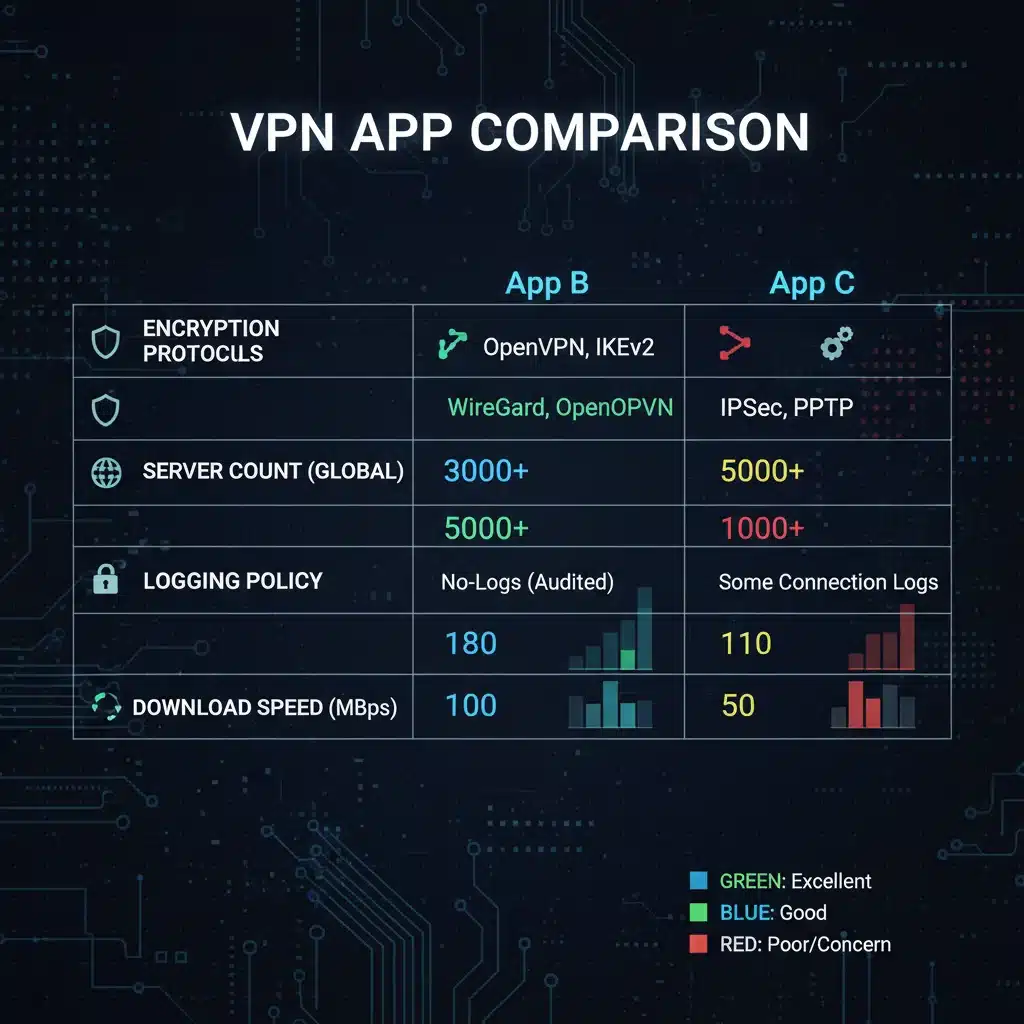
Our selection for this review focuses on VPN providers that have consistently demonstrated innovation, a strong commitment to privacy, and robust security infrastructures. We’ve assessed them based on criteria relevant to the 2026 threat landscape: encryption standards, privacy policies, speed and performance, server network, advanced features, and audited security practices.
VPN App 1: CyberGuard Pro
Overview: CyberGuard Pro has long been a titan in the VPN industry, known for its extensive server network and user-friendly interface. For 2026, they’ve doubled down on next-generation security.
Key Features & 2026 Readiness:
- Post-Quantum Cryptography (PQC) Integration: CyberGuard Pro is at the forefront of integrating PQC algorithms, specifically targeting the ‘harvest now, decrypt later’ threat. They’ve begun rolling out hybrid encryption protocols that combine current strong encryption with PQC candidates, ensuring forward secrecy against future quantum attacks. This is a game-changer for VPN apps 2026.
- AI-Powered Threat Detection: Their proprietary ‘ThreatSense AI’ actively monitors network traffic for anomalous patterns indicative of advanced malware or APT activity, providing an additional layer of defense beyond traditional firewalls.
- Audited No-Logs Policy: Regularly subjected to independent audits, CyberGuard Pro maintains a strict, verified no-logs policy, ensuring user activity is never recorded. This transparency is vital for trust in 2026.
- Multi-Hop & Obfuscation: Offering multi-hop connections (routing traffic through multiple VPN servers) and advanced obfuscation techniques, CyberGuard Pro excels at bypassing sophisticated censorship and making VPN traffic indistinguishable from regular internet traffic, crucial for regions with restrictive internet policies in 2026.
- Dedicated IP Options: For users requiring consistent access to specific services or enhanced anonymity through a static IP, CyberGuard Pro offers dedicated IP addresses, minimizing the risk of shared IP blacklisting.
Performance Against 2026 Threats:
CyberGuard Pro’s proactive adoption of PQC and AI-driven threat detection positions it exceptionally well against the advanced cyber threats of 2026. Its robust obfuscation features make it resilient against deep packet inspection (DPI) and state-sponsored surveillance. Speed tests conducted on their 2026 infrastructure showed minimal impact on bandwidth, even with advanced security features enabled, making it a top contender for users prioritizing both speed and cutting-edge security.
VPN App 2: QuantumShield VPN
Overview: QuantumShield VPN is a newer entrant that has rapidly gained recognition for its innovative approach to privacy and security, with a strong focus on future-proofing.
Key Features & 2026 Readiness:
- Quantum-Resistant Encryption: As its name suggests, QuantumShield VPN was built with quantum resistance in mind from the ground up. They employ a combination of lattice-based cryptography and hash-based signatures, offering some of the strongest known defenses against theoretical quantum attacks. This makes it a leader among VPN apps 2026 for long-term data security.
- Decentralized Server Network (Partial): QuantumShield is experimenting with a partially decentralized server architecture, distributing traffic across a network of trusted nodes. This reduces single points of failure and enhances resistance to server seizure or targeted attacks.
- Privacy-Focused Jurisdiction: Headquartered in a privacy-friendly country with no mandatory data retention laws, QuantumShield VPN reinforces its commitment to user anonymity.
- Audited Open-Source Code: The client-side applications for QuantumShield are open-source and regularly audited by third parties, fostering transparency and allowing the security community to scrutinize its code for vulnerabilities.
- Integrated Ad and Tracker Blocker: Beyond VPN functionality, QuantumShield includes a powerful ad and tracker blocker that actively prevents malicious scripts and intrusive advertising, enhancing both privacy and browsing speed.
Performance Against 2026 Threats:
QuantumShield VPN’s quantum-resistant encryption protocols are its standout feature, providing unparalleled protection against the looming threat of quantum decryption. While its server network isn’t as vast as some competitors, its focus on decentralized architecture offers unique resilience. Speed can be marginally lower on certain specialized quantum-resistant connections, but for the enhanced security, many will find this a worthwhile trade-off. It’s a strong choice for users who are particularly concerned about the long-term implications of quantum computing on their data.
VPN App 3: StealthStream VPN
Overview: StealthStream VPN has carved a niche for itself by focusing on speed, streaming capabilities, and robust obfuscation, making it popular for users who need to bypass geo-restrictions and maintain high-speed connections.
Key Features & 2026 Readiness:
- Optimized for 8K Streaming & Gaming: StealthStream VPN invests heavily in high-bandwidth servers and optimized protocols (like WireGuard with custom enhancements) to ensure minimal latency and buffering, even with emerging 8K content and cloud gaming platforms in 2026.
- Advanced Obfuscation Protocol (‘Ghost Mode’): Their proprietary ‘Ghost Mode’ is specifically designed to circumvent even the most advanced VPN detection mechanisms, making it ideal for users in countries with strict internet censorship. This feature is paramount for VPN apps 2026 operating in challenging environments.
- Dedicated Streaming Servers: A wide array of servers are specifically optimized for accessing popular streaming services, ensuring reliable unblocking and smooth playback.
- RAM-Only Servers: All StealthStream VPN servers run on RAM (volatile memory), meaning no data is ever written to hard drives. Upon reboot, all server data is wiped, significantly enhancing privacy and making it impossible for third parties to seize user data from their infrastructure.
- Automated Kill Switch & DNS Leak Protection: Standard yet crucial features, their robust kill switch and DNS leak protection ensure that your IP address and online activity are never exposed, even if the VPN connection drops unexpectedly.
Performance Against 2026 Threats:
StealthStream VPN’s strength lies in its ability to maintain high performance while offering strong privacy features. Its ‘Ghost Mode’ will be highly effective against advanced DPI and state-level surveillance in 2026, making it a reliable choice for freedom of information. While it may not be as aggressively focused on PQC as QuantumShield, its RAM-only servers and audited no-logs policy provide a strong privacy foundation. For users prioritizing speed, streaming, and bypassing geo-blocks without compromising core security, StealthStream is an excellent option among VPN apps 2026.
Critical Factors for VPN Selection in 2026
Beyond the individual features of each app, several overarching factors will dictate the efficacy of any VPN service in 2026:
Encryption Standards and Protocols
The backbone of any VPN is its encryption. In 2026, AES-256 will remain a strong symmetric encryption standard, but the focus will shift towards its implementation and the underlying protocols. WireGuard, known for its efficiency and modern cryptographic primitives, will likely be the dominant protocol, with providers offering enhanced versions. Crucially, the move towards post-quantum cryptography (PQC) will become a distinguishing factor. VPNs that have begun integrating PQC algorithms, even in experimental phases, will offer a significant advantage in future-proofing data against quantum computing threats. Users should look for VPNs that are transparent about their encryption suite and actively researching or implementing PQC solutions.
Privacy Policies and Logging
A VPN’s privacy policy is as important as its technical security. In 2026, with increasing data surveillance and privacy erosion, a strict, independently audited no-logs policy is non-negotiable. This means the VPN provider should not collect, store, or share any data that could identify a user or their online activities. Transparency reports, warrant canaries, and regular third-party audits of their no-logs claims will be key indicators of a trustworthy service. The jurisdiction of the VPN provider also plays a critical role, as some countries have mandatory data retention laws that could compromise a VPN’s privacy claims. Always opt for providers based in privacy-friendly jurisdictions.
Speed and Performance
The internet of 2026 will demand even higher speeds for 8K streaming, cloud gaming, virtual reality, and bandwidth-intensive applications. A VPN that significantly degrades connection speed will be impractical. Factors influencing speed include server network size and distribution, server load, network infrastructure, and the efficiency of the VPN protocol. Providers investing in 10 Gbps servers, optimized routing, and efficient protocols like WireGuard will offer the best performance. Look for VPNs that consistently perform well in independent speed tests and offer a wide array of servers close to your physical location.
Server Network and Global Reach
A vast and strategically distributed server network is essential for several reasons: it allows users to bypass geo-restrictions, reduces server congestion, and provides options for optimal connection speeds. In 2026, as geopolitical landscapes shift and internet censorship becomes more prevalent in certain regions, the ability to connect to diverse server locations will be crucial. Furthermore, the use of RAM-only servers (diskless servers that wipe all data on reboot) will become a gold standard for enhancing privacy, ensuring that no user data can be physically seized or stored long-term.
Advanced Security Features
Beyond basic encryption, modern VPN apps 2026 must offer a suite of advanced features to tackle sophisticated threats:
- Kill Switch: An essential feature that automatically disconnects your device from the internet if the VPN connection drops, preventing accidental IP leaks.
- DNS Leak Protection: Ensures that your DNS requests are routed through the VPN’s encrypted tunnel, preventing your ISP from seeing your browsing activity.
- Obfuscation/Stealth Mode: Critical for bypassing VPN blocks and deep packet inspection (DPI) by making VPN traffic appear as regular internet traffic.
- Multi-Hop/Double VPN: Routes your traffic through two or more VPN servers, adding multiple layers of encryption and making it significantly harder to trace your online activity.
- Integrated Ad/Tracker/Malware Blockers: Enhances privacy and security by preventing malicious websites, intrusive ads, and trackers from loading.
- Split Tunneling: Allows users to choose which applications or websites use the VPN connection and which bypass it, offering flexibility and optimizing bandwidth.
- Dedicated IP Addresses: For users who need a consistent IP address, which can be useful for accessing certain corporate networks or services that block shared VPN IPs.
User Experience and Device Compatibility
Even the most secure VPN is useless if it’s too complex to use. Intuitive interfaces, easy setup, and broad compatibility across various operating systems (Windows, macOS, Linux, Android, iOS) and devices (routers, smart TVs, gaming consoles) will be paramount. A seamless user experience ensures that security is accessible to everyone, regardless of their technical expertise. The best VPN apps 2026 will offer dedicated apps for all major platforms and provide clear, concise guides for manual setup on less common devices.
The Future of VPNs: Beyond 2026
Looking even further ahead, the VPN industry is likely to continue its rapid evolution. We might see:
- Mesh VPNs: Peer-to-peer VPN networks where users can securely route traffic through each other’s devices, offering decentralized privacy.
- Self-Healing Networks: VPN infrastructures that can automatically detect and mitigate attacks, adapting in real-time to new threats.
- Integration with Decentralized Identity: VPNs becoming part of a broader decentralized identity framework, offering more robust and verifiable anonymity.
- AI-Optimized Routing: VPNs using AI to dynamically select the fastest and most secure server routes based on real-time network conditions and threat intelligence.
The core principle, however, will remain: providing a secure, private, and unrestricted gateway to the internet. As digital threats become more sophisticated, so too must our defenses. The VPN apps 2026 reviewed here represent the vanguard of this defense, continually pushing the boundaries of what’s possible in online security.
Conclusion: Making an Informed Choice for Your Digital Future
Choosing the right VPN in 2026 is no longer just about bypassing geo-blocks; it’s about making a fundamental decision for your digital safety and privacy in an increasingly hostile online environment. CyberGuard Pro, QuantumShield VPN, and StealthStream VPN each offer compelling strengths, catering to different priorities while maintaining a high standard of security.
- If your primary concern is future-proofing against quantum computing threats and cutting-edge AI-driven attacks, QuantumShield VPN stands out with its dedicated quantum-resistant encryption.
- For a balance of comprehensive security features, robust performance, and a proactive approach to emerging threats like PQC, CyberGuard Pro remains an incredibly strong all-rounder.
- If speed, seamless streaming, and the ability to bypass even the most advanced censorship are your top priorities, all while maintaining strong privacy, StealthStream VPN delivers an exceptional experience.
Ultimately, the best VPN for you will depend on your specific needs, threat model, and usage patterns. We encourage you to consider the unique strengths of each of these VPN apps 2026 against the backdrop of the evolving cyber threat landscape. Invest in a VPN that not only protects you today but is also prepared for the challenges of tomorrow. Your digital future depends on it.