Edge Computing on Mobile: 3 Practical Solutions for Faster App Performance by Mid-2026

In the rapidly evolving landscape of mobile technology, where user expectations for instantaneous responses and seamless experiences are higher than ever, traditional cloud computing models are beginning to show their limitations. The sheer volume of data generated by mobile devices, coupled with the increasing demand for real-time processing, has paved the way for a transformative paradigm: mobile edge computing. This innovative approach brings computation and data storage closer to the source of data generation – the mobile device itself – drastically reducing latency and enhancing application performance. By mid-2026, mobile edge computing is poised to become a cornerstone of high-performance mobile applications, and understanding its practical solutions is crucial for developers and businesses alike.
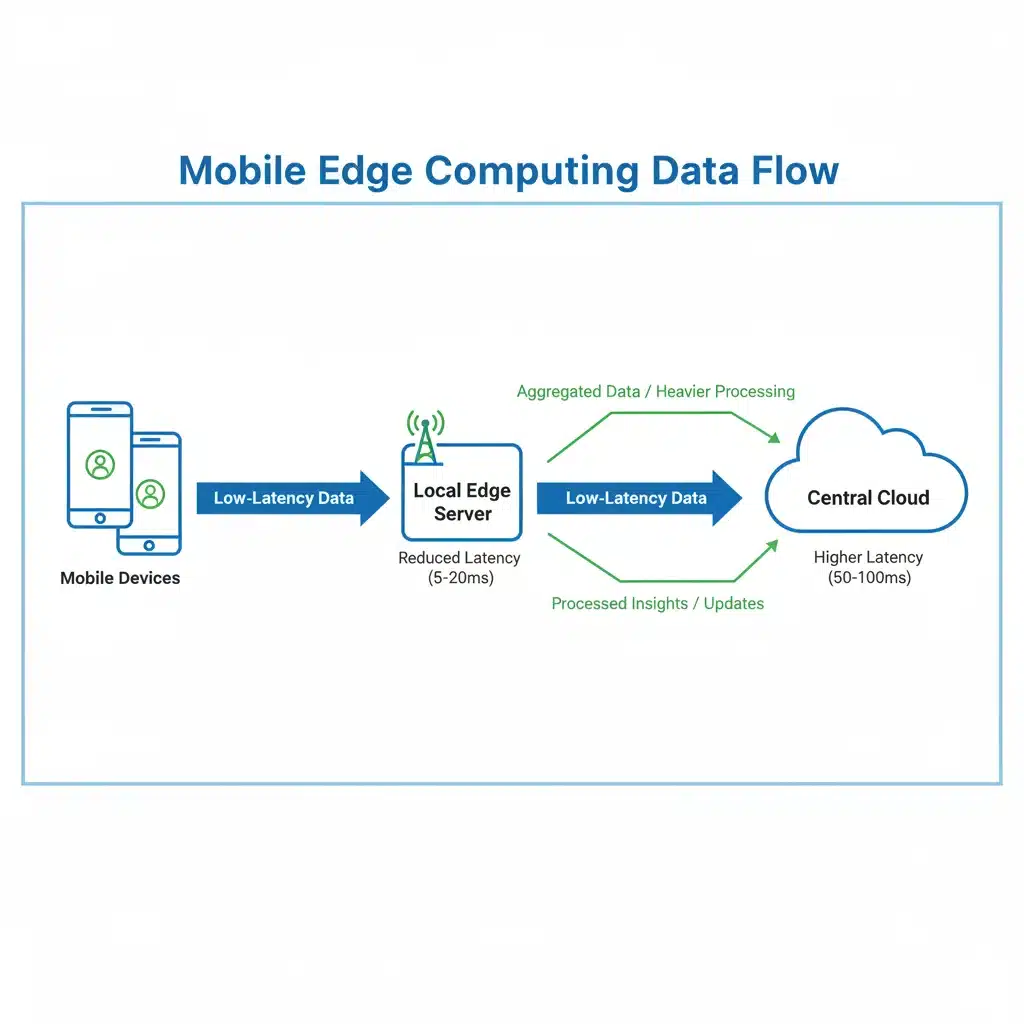
The promise of mobile edge computing lies in its ability to circumvent the bottlenecks associated with sending all data to a centralized cloud server for processing. Imagine a scenario where your augmented reality (AR) application needs to overlay digital information onto the real world with sub-millisecond precision. Or a self-driving car requiring immediate analysis of its surroundings to make critical decisions. In such cases, the round-trip time to a distant cloud server is simply unacceptable. Edge computing tackles this by deploying mini-data centers, or ‘edge nodes,’ at the network’s periphery, often in close proximity to end-users or data sources. This geographical closeness translates directly into faster data processing, lower bandwidth consumption, and enhanced reliability, even in areas with intermittent connectivity.
The impact of mobile edge computing extends far beyond just speed. It’s about enabling a new generation of applications that were previously impossible due to latency constraints. From immersive gaming and real-time analytics to industrial IoT and smart city initiatives, the potential applications are vast and varied. This article will delve into three practical solutions that are driving the adoption of mobile edge computing and are expected to significantly boost mobile app performance by mid-2026. We’ll explore how these solutions are being implemented, their benefits, and the challenges they aim to overcome, providing a comprehensive overview for anyone looking to leverage this cutting-edge technology.
1. Distributed Machine Learning at the Edge
One of the most impactful applications of mobile edge computing is in the realm of machine learning (ML). Traditional ML models are often trained and deployed in the cloud, requiring significant data transfer and processing power. However, for mobile applications that rely on real-time inference – such as facial recognition, predictive text, voice assistants, or anomaly detection in health monitoring – cloud-based ML can introduce unacceptable delays. Distributed machine learning at the edge addresses this by bringing ML inference capabilities directly onto the mobile device or nearby edge servers.
How it Works:
Instead of sending raw data to the cloud for inference, edge ML models are trained in the cloud and then optimized and deployed to edge devices. This can involve techniques like model compression, quantization, and pruning to reduce the model’s size and computational requirements, making it suitable for resource-constrained mobile environments. When the mobile application needs to perform an ML inference, it does so locally on the device or by offloading the task to a nearby edge server. Only aggregated results or specific data points might be sent back to the cloud for further analysis or model retraining, significantly reducing bandwidth usage and improving privacy.
Benefits for Mobile App Performance:
- Ultra-Low Latency: Inference happens almost instantaneously, as data doesn’t need to travel to a distant data center. This is critical for real-time applications like AR/VR, autonomous systems, and instant language translation.
- Enhanced Privacy and Security: Sensitive user data can be processed locally, reducing the risk of data breaches during transit to the cloud. Only anonymized or aggregated insights may leave the device.
- Offline Functionality: Mobile applications can continue to perform ML inferences even without a stable internet connection, crucial for remote areas or during network outages.
- Reduced Cloud Costs: Less data transferred to and processed in the cloud translates to lower operational expenses for developers and businesses.
- Improved Energy Efficiency: While processing on the device consumes battery, intelligently offloading to nearby edge servers can optimize energy use by leveraging more powerful, dedicated hardware.
Challenges and Future Outlook:
Implementing distributed ML at the edge presents challenges, including managing model updates across numerous devices, ensuring model accuracy with limited local data, and securing edge infrastructure. However, advancements in federated learning, which allows models to be trained on decentralized datasets without explicit data sharing, and more powerful mobile chipsets with dedicated AI accelerators, are rapidly overcoming these hurdles. By mid-2026, we can expect to see a proliferation of mobile applications leveraging distributed ML for highly personalized, responsive, and secure experiences, making mobile edge computing an indispensable part of their architecture.
2. Edge Caching and Content Delivery Networks (CDNs)
Another fundamental way mobile edge computing is boosting app performance is through advanced edge caching and localized Content Delivery Networks (CDNs). While CDNs have been around for a while, the concept of ‘edge CDN’ takes this a step further by placing content even closer to the end-user, often within the mobile network operator’s infrastructure or at base stations.
How it Works:
Traditional CDNs distribute content (images, videos, web pages, application assets) across a global network of servers. When a user requests content, it’s delivered from the geographically closest server. Edge caching amplifies this by deploying smaller, more localized caches at the very edge of the network. These edge caches store frequently accessed content, application components, and even dynamically generated data. When a mobile app requests data, the edge cache is checked first. If the content is available locally, it’s delivered almost instantly, bypassing the need to retrieve it from a central cloud server or even a regional CDN node.
Benefits for Mobile App Performance:
- Significantly Faster Load Times: Retrieving content from a nearby edge cache reduces network latency to a minimum, resulting in quicker loading times for mobile applications, especially those rich in media content.
- Reduced Bandwidth Consumption: Less data needs to be fetched from central servers, conserving bandwidth for both the user and the network provider. This is particularly beneficial in areas with limited or costly data plans.
- Improved User Experience: Faster loading times and smoother content delivery lead to a more responsive and enjoyable user experience, crucial for engagement and retention.
- Enhanced Reliability: Even if the connection to the central cloud is temporarily disrupted, users can still access cached content, ensuring a more resilient application experience.
- Scalability: Edge caching allows applications to scale more effectively by distributing the content delivery load across numerous edge nodes, preventing bottlenecks at central servers.
Challenges and Future Outlook:
The main challenges involve intelligent caching strategies – deciding what content to cache, for how long, and how to invalidate it when updates occur. Dynamic content and personalized experiences also pose complexities. However, with the advent of 5G networks, which provide unprecedented bandwidth and ultra-low latency, edge CDNs are becoming even more powerful. 5G infrastructure often integrates edge computing capabilities directly, allowing for seamless content pre-fetching and dynamic caching based on user behavior and location. By mid-2026, edge caching will be an invisible yet critical component of almost every high-performing mobile application, ensuring content is always just a ‘hop’ away, significantly improving the overall experience of mobile edge computing.
3. Edge-Native Application Architectures
The third practical solution involves a fundamental shift in how mobile applications are designed and developed: embracing edge-native architectures. Rather than simply offloading some tasks to the edge, edge-native applications are built from the ground up to leverage the unique capabilities of mobile edge computing, distributing their logic and data across devices, edge servers, and the cloud in an optimized manner.
How it Works:
An edge-native application is not just a mobile app that uses an edge service; it’s an application whose core design principles revolve around distributed processing. This means breaking down the application into microservices or functions that can run optimally at different tiers: on the device, on a nearby edge server, or in the central cloud. For example, a gaming application might handle real-time physics calculations on the device, complex AI opponents on a local edge server for ultra-low latency, and user profile management in the cloud. Data synchronization mechanisms ensure consistency across these distributed components, while intelligent orchestration manages where and when different parts of the application execute.

Benefits for Mobile App Performance:
- Optimal Resource Utilization: Tasks are executed where they are most efficient – compute-intensive tasks on edge servers, simple UI logic on the device, and archival storage in the cloud.
- Resilience and Fault Tolerance: If one part of the distributed system fails (e.g., cloud connectivity is lost), other parts can continue to function, providing a more robust user experience.
- Enhanced Scalability: Applications can scale horizontally by adding more edge nodes as user demand grows in specific geographical areas, rather than relying solely on central cloud expansion.
- Reduced Latency and Bandwidth: By keeping relevant data and processing localized, the need for long-haul data transfers is minimized, leading to superior responsiveness.
- New Application Possibilities: This architecture enables entirely new categories of applications, particularly those requiring real-time interaction with the physical world, such as industrial automation, smart retail, and collaborative AR experiences.
Challenges and Future Outlook:
Developing edge-native applications requires a different mindset and new tools. It introduces complexities in terms of distributed data management, service orchestration, security across multiple tiers, and debugging. However, frameworks and platforms specifically designed for edge development are emerging, simplifying the process. Technologies like Kubernetes for edge orchestration, serverless functions at the edge, and standardized APIs for edge resource access are maturing rapidly. By mid-2026, we will see a significant shift towards edge-native development, with many new mobile applications being conceived with mobile edge computing at their core, unlocking unprecedented levels of performance and functionality.
The Broader Impact of Mobile Edge Computing
The implications of widespread mobile edge computing adoption extend far beyond individual application performance. It’s set to reshape entire industries and user behaviors. Consider the transformation in mobile gaming, where cloud gaming platforms could leverage edge servers to provide console-quality experiences on smartphones with virtually no lag. In healthcare, real-time analysis of patient data from wearables could be performed at the edge, enabling immediate alerts for critical conditions. For autonomous vehicles, edge computing is not just an enhancement but a necessity, providing the instantaneous decision-making capabilities required for safety and efficiency.
Security and Privacy Considerations:
While edge computing offers significant privacy benefits by keeping data local, it also introduces new security challenges. Distributing data and computation across more nodes increases the attack surface. Robust security measures, including end-to-end encryption, secure boot processes for edge devices, and advanced access control mechanisms, are paramount. Developers must prioritize a ‘security-by-design’ approach when building edge-native applications, ensuring that each component, whether on the device, edge, or cloud, adheres to the highest security standards. The decentralized nature of mobile edge computing demands a holistic security strategy that accounts for every potential vulnerability point.
The Role of 5G in Accelerating Edge Adoption:
It’s impossible to discuss mobile edge computing without acknowledging the pivotal role of 5G networks. 5G’s key characteristics – ultra-low latency, massive bandwidth, and the ability to connect a vast number of devices – are perfectly complementary to edge computing. 5G networks are designed with edge capabilities baked in, allowing for seamless integration of edge servers within the network infrastructure. This synergy creates a powerful ecosystem where mobile applications can truly leverage the full potential of both technologies. As 5G deployment continues to expand globally, the acceleration of mobile edge computing adoption will undoubtedly follow, making these practical solutions more accessible and impactful than ever before.
Economic and Business Implications:
For businesses, embracing mobile edge computing is not just about technological advancement; it’s about gaining a competitive edge. Faster, more reliable, and more secure mobile applications lead to higher user satisfaction, increased engagement, and ultimately, greater revenue. Companies that invest in edge-native development and infrastructure will be better positioned to innovate, offer differentiated services, and capture market share in a mobile-first world. The ability to process data closer to the source also opens up new possibilities for data monetization and localized service delivery, creating new business models and revenue streams. The cost savings from reduced data transfer and optimized cloud usage can also be substantial, providing a strong economic incentive for adoption.
Conclusion
The future of mobile application performance is undeniably intertwined with mobile edge computing. The three practical solutions discussed – distributed machine learning at the edge, advanced edge caching and CDNs, and edge-native application architectures – represent fundamental shifts in how we design, deploy, and interact with mobile applications. By mid-2026, these solutions will not be niche technologies but rather standard practices for any developer or business aiming to deliver a superior mobile experience. The ongoing convergence of 5G, AI, and edge computing is creating an unprecedented opportunity to build applications that are more responsive, resilient, intelligent, and private than ever before.
As the digital and physical worlds continue to merge, the ability to process information at the point of interaction will become increasingly vital. Mobile edge computing is the key to unlocking this potential, transforming mobile devices from mere endpoints into powerful, intelligent hubs. For developers, this means a new frontier of innovation; for businesses, a pathway to competitive advantage; and for users, an era of unparalleled mobile experiences. The journey to a fully edge-enabled mobile ecosystem is well underway, and understanding these practical solutions is the first step towards navigating and thriving in this exciting new landscape.