
Mobile AI Processors: Unpacking the 4 Key Advancements for 2026 Devices
The relentless march of technology ensures that our smartphones and mobile devices are constantly evolving, becoming more powerful, intuitive, and indispensable. At the heart of this evolution lies the mobile AI processor, a specialized component designed to handle the complex computations required for artificial intelligence tasks. As we look towards 2026, the landscape of mobile AI is set for a dramatic transformation, driven by four pivotal advancements in mobile AI processors. These innovations are not just incremental upgrades; they represent a fundamental shift in how our devices will perceive, process, and interact with the world around us.
From enhanced on-device learning to unparalleled energy efficiency, the next generation of mobile AI processors promises to unlock capabilities that were once confined to science fiction. This comprehensive guide will delve deep into these four key advancements, exploring their technological underpinnings, their impact on user experience, and what they mean for the future of mobile computing. Prepare to discover how your 2026 device will be smarter, faster, and more personal than ever before.
The Dawn of Hyper-Efficient Neural Processing Units (NPUs)
One of the most significant advancements in mobile AI processors for 2026 devices will be the proliferation of hyper-efficient Neural Processing Units (NPUs). While NPUs are not entirely new, their evolution in terms of efficiency, raw processing power, and specialized architecture is reaching unprecedented levels. Current NPUs are capable, but often operate within a power budget that limits sustained, complex AI tasks directly on the device. The next generation will overcome these limitations.
Redefining On-Device AI Capabilities
These new NPUs will feature significantly more dedicated AI cores, optimized instruction sets, and advanced memory architectures specifically designed for neural network operations. This means that tasks traditionally offloaded to cloud servers – such as advanced natural language processing, complex image and video analysis, and sophisticated predictive modeling – will increasingly be handled locally on your smartphone. The benefits are manifold: reduced latency, enhanced privacy (as data doesn’t leave your device), and the ability to perform AI tasks even without an internet connection.
Consider the implications for real-time applications. Imagine a camera app that not only recognizes objects and scenes with incredible accuracy but can also perform complex stylistic transfers or generate entirely new image elements in milliseconds, all without a perceptible delay. Or think about voice assistants that understand nuanced context, adapt to your speech patterns over time, and execute multi-step commands with a fluidity that feels genuinely conversational. These are the kinds of experiences that hyper-efficient NPUs will enable, transforming everyday interactions into seamless, intelligent engagements.
Architectural Innovations for Peak Performance
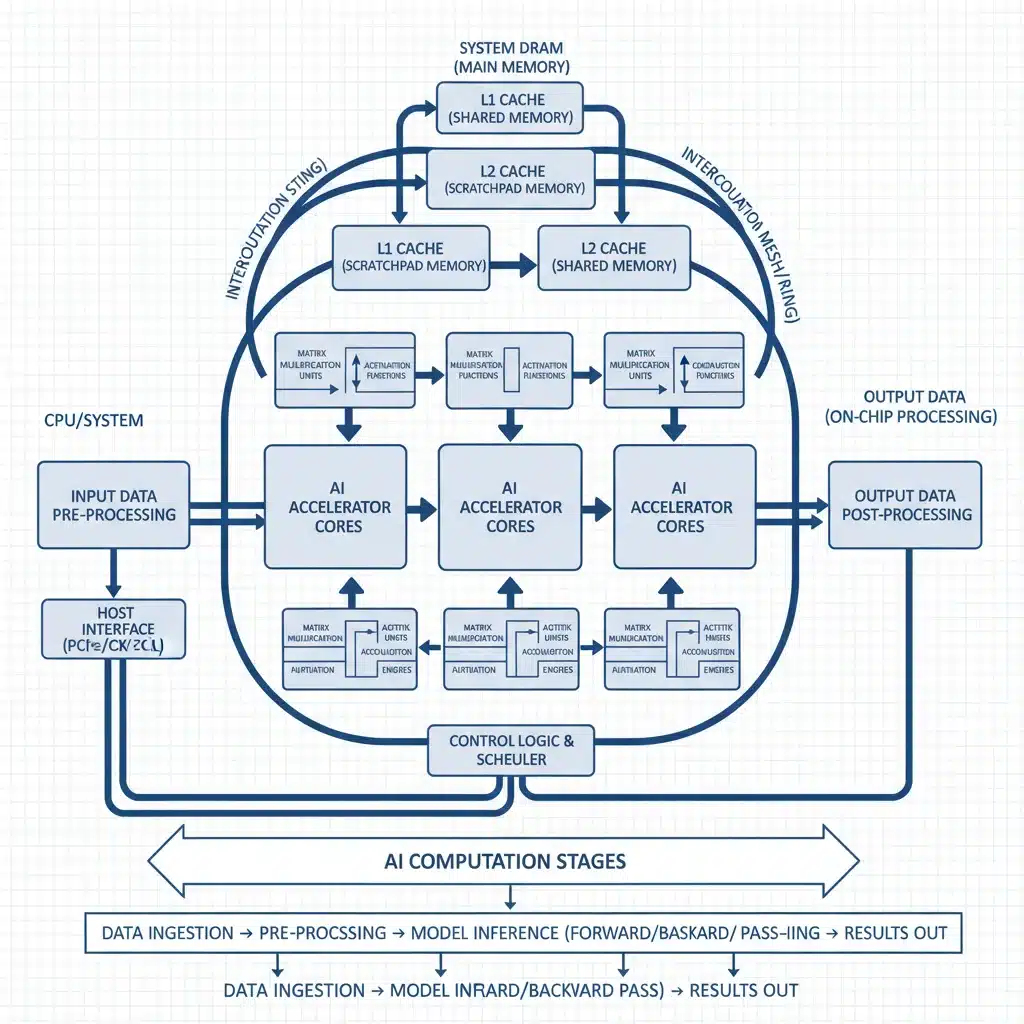
The efficiency gains will come from several architectural innovations. Expect to see heterogeneous computing designs where different types of cores (CPU, GPU, NPU) work in perfect synergy, each handling the tasks they are best suited for. Furthermore, next-gen NPUs will likely incorporate more advanced quantization techniques, allowing neural networks to run with high accuracy using fewer bits per weight, thus reducing computational load and memory footprint. Dedicated on-chip memory for AI models, coupled with faster interconnects to main system memory, will also play a crucial role in minimizing bottlenecks and maximizing throughput. This focus on specialized, integrated hardware is what truly sets these future mobile AI processors apart, making on-device AI a cornerstone of the 2026 mobile experience.
Enhanced Contextual Awareness and Adaptive Learning
The second major advancement in mobile AI processors will be their significantly enhanced ability to understand and adapt to user context. Current AI systems often operate based on predefined models or limited real-time data. Future processors will be designed to continuously learn from user behavior, environmental cues, and sensor data, creating a truly personalized and proactive mobile experience.
Proactive Personalization and Predictive Intelligence
This goes beyond simply suggesting apps or content based on past usage. Imagine a smartphone that anticipates your needs before you even articulate them. For example, if you routinely check traffic before your morning commute, your device might proactively display the optimal route and current traffic conditions on your lock screen at the appropriate time, even without you opening a map application. If it detects you’re in a new city, it might automatically suggest local points of interest or translate signage in real-time, learning your preferences for exploration as you go.
This level of contextual awareness requires sophisticated AI models that can process vast amounts of disparate data streams – from location and time to calendar events, communication patterns, and even biometric data – and infer meaningful insights. The mobile AI processors of 2026 will be equipped with specialized hardware accelerators for these types of complex, multi-modal sensor fusion and inference tasks. They will be capable of building and refining a dynamic ‘digital twin’ of your daily life, enabling truly predictive and helpful AI.
Federated Learning and Privacy-Preserving AI
Crucially, this enhanced contextual awareness will be achieved with a strong emphasis on user privacy. Advancements in federated learning – where AI models are trained on decentralized data residing on individual devices without ever sending raw data to the cloud – will become standard. This means your device learns about you, but your personal data remains securely on your device. The mobile AI processors will include hardware-level security features to protect these sensitive AI models and the data they process, ensuring that personalization doesn’t come at the cost of privacy. This delicate balance between powerful AI and robust privacy will be a defining characteristic of next-generation mobile devices.
Revolutionary Energy Efficiency for Sustained AI Workloads
The third critical advancement in mobile AI processors for 2026 is a revolutionary leap in energy efficiency. As AI tasks become more complex and pervasive, the power consumption of NPUs could become a significant bottleneck, impacting battery life and thermal management. Future processors are designed to tackle this head-on, enabling sustained, high-performance AI operations without draining your device’s power.
From Milliseconds to Hours: Always-On AI
Current mobile AI often operates in bursts, activating the NPU for short periods to handle specific tasks and then returning to a low-power state. While effective, this approach limits the scope of ‘always-on’ AI features. The 2026 generation of mobile AI processors will feature dramatically improved power-per-inference ratios, allowing AI models to run continuously in the background with minimal impact on battery life. This means features like continuous environmental sensing, proactive health monitoring, or advanced noise cancellation can operate persistently, enhancing the user experience without compromise.
Achieving this level of efficiency involves a combination of factors: advanced manufacturing processes (e.g., 2nm or even 1nm process nodes), innovative circuit designs that minimize leakage current, and dynamic voltage and frequency scaling (DVFS) tailored specifically for AI workloads. Furthermore, specialized memory types like In-Memory Computing (IMC) or Near-Memory Computing (NMC) could become more prevalent, drastically reducing the energy cost of moving data between the NPU and memory – a major power consumer in traditional architectures. These improvements will allow devices to sustain complex AI operations for hours, not just milliseconds, truly enabling the vision of an intelligent, ever-aware companion.
Optimized for Edge AI
This focus on energy efficiency is paramount for the broader trend of edge AI – bringing AI processing closer to the data source. For mobile devices, this means less reliance on cloud computing, which translates to faster responses, greater reliability in areas with poor connectivity, and reduced data transmission costs. The mobile AI processors of 2026 will be the workhorses of this edge AI revolution, making smart devices truly self-sufficient and intelligent in their own right. This efficiency will also extend to the training of smaller, personalized AI models directly on the device, further reducing the need for cloud interaction and bolstering privacy.
Seamless Integration of Generative AI Capabilities
The fourth, and arguably most exciting, advancement in mobile AI processors will be their seamless integration and acceleration of generative AI capabilities. While large language models (LLMs) and generative adversarial networks (GANs) have made headlines in cloud computing, bringing these complex models to mobile devices in a meaningful way requires specialized hardware and significant optimization. By 2026, mobile AI processors will be purpose-built to handle these generative tasks efficiently.
Unlocking Creativity and Productivity On-the-Go
Imagine a smartphone that can instantly summarize lengthy documents, draft emails in your personal style, or even generate unique images and videos based on simple text prompts, all performed locally on your device. These are the kinds of generative AI capabilities that future mobile AI processors will enable. This means content creation, communication, and problem-solving will be transformed. Students could generate study notes from lectures, professionals could create compelling presentations from bullet points, and artists could conceptualize designs with unprecedented speed and flexibility – all from their mobile device.
The challenge lies in running these massive models, which can have billions of parameters, on resource-constrained mobile hardware. The 2026 mobile AI processors will address this through several innovations: advanced model compression techniques (e.g., distillation, pruning, and quantization to ultra-low bitwidths), specialized hardware accelerators for transformer architectures (the backbone of many generative models), and efficient memory management to swap model layers in and out of fast on-chip memory as needed. Furthermore, the ability to fine-tune pre-trained models with user-specific data on-device will allow for highly personalized generative outputs, making the AI truly yours.
Democratizing Advanced AI
This integration of generative AI will democratize access to advanced creative and analytical tools. No longer will you need powerful desktop machines or constant cloud connectivity to leverage these cutting-edge capabilities. Your pocket-sized device will become a hub for innovation, enabling a new wave of mobile applications that leverage on-device generative AI for everything from personalized tutoring to dynamic game content generation. The potential for enhancing productivity and creativity across all sectors is immense, making these mobile AI processors a truly transformative force.
The Synergistic Impact of These Advancements
It’s crucial to understand that these four advancements in mobile AI processors don’t operate in isolation; they are deeply interconnected and will amplify each other’s impact. Hyper-efficient NPUs provide the raw horsepower, allowing for more complex AI models to run on-device. Enhanced contextual awareness leverages this power to make AI more personalized and proactive, continuously learning without compromising privacy. Revolutionary energy efficiency ensures that these sophisticated AI tasks can run sustainably, enabling always-on intelligence. Finally, the seamless integration of generative AI harnesses all these capabilities to unlock new levels of creativity and productivity directly from your mobile device.
A New Paradigm for Mobile Computing
Together, these advancements will usher in a new paradigm for mobile computing. Smartphones and other portable devices will evolve from mere tools into intelligent companions that proactively assist, learn, and create alongside their users. The distinction between local and cloud processing will blur, with devices intelligently distributing workloads to optimize for speed, privacy, and power consumption. This holistic approach to AI hardware design will lead to user experiences that feel genuinely intuitive, responsive, and deeply integrated into our daily lives.
Consider the future of augmented reality (AR) or mixed reality (MR) on mobile. With powerful, energy-efficient mobile AI processors, devices can perform real-time 3D environment mapping, object recognition, and content rendering with unprecedented fidelity and minimal latency. Generative AI could dynamically create virtual objects or characters that seamlessly interact with your physical environment, all while the device intelligently adapts to your movements and intentions. This level of immersion and interactivity will redefine how we experience digital content and interact with the real world through our mobile screens.
Challenges and the Road Ahead
While the future of mobile AI processors looks incredibly promising, significant challenges remain. Miniaturization and thermal management will continue to be critical hurdles, as more powerful components are packed into ever-smaller form factors. The software ecosystem will also need to evolve rapidly, with developers needing new tools and frameworks to fully leverage the capabilities of these advanced NPUs. Furthermore, ethical considerations surrounding AI, such as bias in models and the responsible use of generative AI, will become even more pertinent as these technologies become ubiquitous and deeply integrated into personal devices.
However, the industry is keenly aware of these challenges and is investing heavily in solutions. Collaborative efforts between chip manufacturers, device makers, and software developers are accelerating innovation. Standardized APIs and open-source frameworks for AI development on mobile are emerging, making it easier for a broader range of developers to build intelligent applications. The focus on privacy-preserving AI and explainable AI is also gaining traction, ensuring that as devices become smarter, they also remain trustworthy and accountable.
Conclusion: The Intelligent Future is Mobile
The four key advancements in mobile AI processors – hyper-efficient NPUs, enhanced contextual awareness, revolutionary energy efficiency, and seamless generative AI integration – are not just technical specifications; they are the building blocks of our intelligent future. By 2026, our mobile devices will be more than just communication tools; they will be highly personalized, proactive, and powerful AI companions that enhance every facet of our lives.
From transforming how we create content and communicate to making our daily routines smoother and more intuitive, the impact of these next-generation mobile AI processors will be profound. As these technologies mature, we can expect a new wave of innovation across industries, with mobile devices serving as the primary interface for an increasingly AI-driven world. The future of mobile computing is not just smart; it’s intelligent, adaptive, and deeply personal, all powered by the remarkable evolution of its core AI engine.
Get ready for a mobile experience that truly understands you, anticipates your needs, and empowers your creativity like never before. The era of truly intelligent mobile devices is almost here, and it’s being built on the foundation of these incredible advancements in mobile AI processors.